 English▼



- Отправить по электронной почте : David@tmaxcn.com
- Отправить по электронной почте : Davidtmaxcn@gmail.com
- : No. 39, Xinchang Road, Xinyang, Haicang Dist., Xiamen, Fujian, China (Mainland)
блог
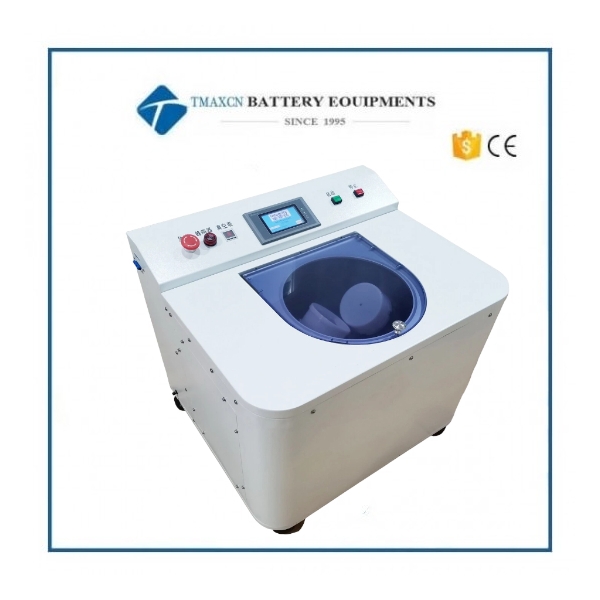
Planetary Centrifugal Mixer
December 23,2025.
Xiamen Tmax Battery Equipments Limited was set up as a manufacturer in 1995, dealing with lithium battery equipments, technology, etc. We have total manufacturing facilities of around 200000 square foot and more than 230 staff. Owning a group of experie-nced engineers and staffs, we can bring you not only reliable products and technology, but also excellent services and real value you will expect and enjoy.
A planetary centrifugal mixer is an advanced mixing device that combines the principles of planetary motion and centrifugal force to achieve highly efficient and uniform mixing of materials. This technology is widely used in industries where precise blending, degassing, and homogenization of viscous materials are required. By rotating the mixing container along two axes simultaneously, the planetary centrifugal mixer ensures thorough mixing without damaging the material structure.
In this article, we will explore the design, operation, advantages, challenges, and applications of planetary centrifugal mixers.
●Design and Operation of Planetary Centrifugal Mixers
1. Key Components
Mixing Container: Holds the materials to be mixed.
Rotating Mechanism: Drives the container in a planetary motion (rotating around its own axis while orbiting a central point).
Centrifugal Force System: Applies centrifugal force to enhance mixing efficiency.
Control Unit: Monitors and regulates speed, time, and other parameters for optimal performance.
Sealing System: Prevents leaks and maintains vacuum conditions during degassing.
2. Operation Principle
The mixing container rotates around its own axis while simultaneously orbiting a central axis, creating a "planetary" motion.
This dual rotation generates strong shear forces and centrifugal effects, ensuring thorough mixing and degassing.
Materials are continuously redistributed within the container, minimizing dead zones and achieving uniform results.
●Advantages of Planetary Centrifugal Mixers
1. High Mixing Efficiency:
Achieves rapid and uniform mixing of materials with varying viscosities and densities.
2. Effective Degassing:
The centrifugal force helps remove air bubbles and voids, resulting in bubblefree mixtures.
3. Versatility:
Suitable for a wide range of materials, including liquids, pastes, powders, and slurries.
4. Minimal Material Damage:
Gentle mixing action prevents damage to delicate materials or particles.
5. Compact Design:
Occupies less space compared to traditional mixing systems, making it ideal for labs and production facilities.
6. Customizable Settings:
Adjustable speed, time, and vacuum levels allow users to tailor the process for specific applications.
●Challenges in Using Planetary Centrifugal Mixers
1. Initial Cost:
High upfront investment for purchasing and setting up the equipment.
2. Material Compatibility:
Some highly reactive or sensitive materials may require specialized containers or coatings.
3. Maintenance Requirements:
Regular cleaning and calibration are necessary to ensure consistent performance.
4. Size Limitations:
Larger batches may require oversized mixers, which can be expensive and technically challenging.
5. Complexity:
Advanced settings and controls may require training for operators to use effectively.
●Innovations in Planetary Centrifugal Mixing Technology
To address these challenges and enhance performance, manufacturers are incorporating cuttingedge technologies:
1. Advanced Control Systems:
Realtime monitoring and dynamic adjustment of mixing parameters for optimal results.
2. Energy Efficiency:
Improved motor designs and power management to reduce energy consumption.
3. IoT Integration:
Connectivity to smart systems for remote monitoring, data logging, and predictive maintenance.
4. Modular Designs:
Flexible configurations allow users to adapt mixers to different sizes and applications.
5. EcoFriendly Solutions:
Use of sustainable materials and energyefficient processes to minimize environmental impact.
●Applications of Planetary Centrifugal Mixers
Planetary centrifugal mixers are widely used across various industries:
1. Adhesives and Sealants:
Mixing and degassing of epoxy resins, silicones, and other adhesive formulations.
2. Electronics:
Blending conductive pastes, soldering materials, and encapsulants for electronic components.
3. Pharmaceuticals:
Homogenizing drug formulations, creams, and ointments for consistent quality.
4. Cosmetics:
Producing lotions, gels, and other personal care products with smooth textures.
5. Food Industry:
Mixing food ingredients like sauces, spreads, and fillings for uniform consistency.
6. Research and Development:
Testing new materials and formulations in laboratory settings.
7. Construction Materials:
Preparing mortars, grouts, and other building materials with precise mixing ratios.
●The Future of Planetary Centrifugal Mixers
As technology continues to evolve, planetary centrifugal mixers will become even more advanced. Key trends shaping the future include:
1. Increased Automation:
Fully autonomous systems will optimize mixing processes and reduce human intervention.
2. Focus on Sustainability:
Ecofriendly designs and energyefficient operations will become standard.
3. Integration with Emerging Technologies:
Combining mixing with AI, IoT, and cloud computing for smarter diagnostics and analysis.
4. Development of New Materials:
Adapting mixers to accommodate advanced materials and formulations for nextgeneration products.
5. Global Standards Compliance:
Ensuring compatibility with evolving international regulations for material processing.
●Conclusion
Planetary centrifugal mixers are powerful tools for achieving highquality mixing, degassing, and homogenization in various industries. Their ability to combine planetary motion and centrifugal force makes them indispensable for applications requiring precision and uniformity.
What excites you most about the role of planetary centrifugal mixers in advancing material processing? Share your thoughts below! Together, let’s explore how this innovative technology can shape the future of mixing and blending solutions.
 +86 13174506016
 David@tmaxcn.com

